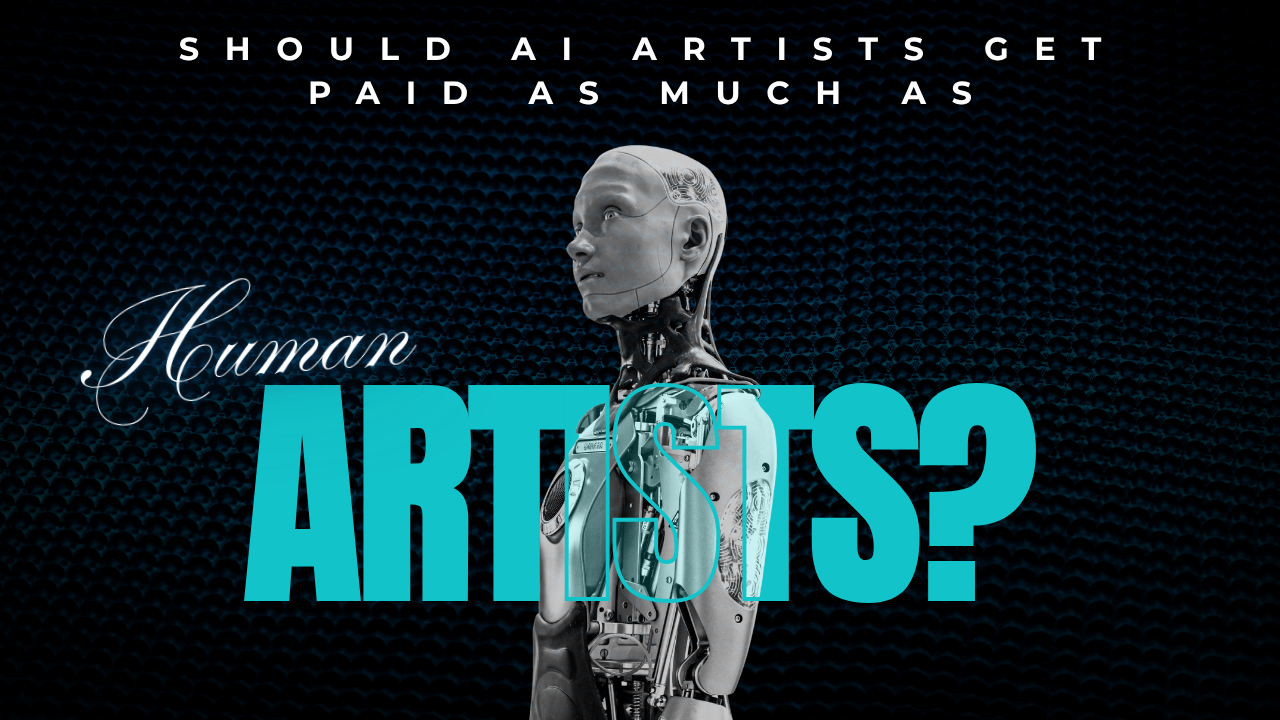
This question is coming up more and more, and for good reason.
AI can now generate songs, voices, lyrics, even full “artists” in minutes; and as the quality improves, the line between human made and machine generated keeps getting harder to see.
So naturally, the conversation shifts to money.
If it sounds the same, should it be paid the same?
On the surface, that feels logical.
But when you look deeper, the answer isn’t that simple.
What Are You Actually Paying For?
Let’s start here, because this is where most people get it wrong.
When you pay an artist, you’re not just paying for the final audio file.
You’re paying for:
- Perspective
- Lived experience
- Creative decision making
- Cultural context
- Emotional connection
A record is not just sound; it’s meaning.
AI can generate a song that sounds right, but it doesn’t live anything, it doesn’t experience anything, and it doesn’t attach real world context to what it creates.
That difference matters.
Because music isn’t just consumed, it’s connected to.
Output Versus Origin
Here’s where the debate gets interesting.
If an AI generated song performs the same as a human made song, streams the same, gets the same engagement, and drives the same revenue, should it be compensated the same?
From a pure output perspective, you could argue yes.
But from an origin perspective, it changes.
AI models are trained on existing human work.
They don’t create in a vacuum; they remix, reinterpret, and regenerate patterns based on what already exists.
So the question becomes less about “should AI get paid” and more about:
Who is the value actually coming from?
Because if the foundation is human creativity, then the compensation conversation has to include that layer.
The Risk of Devaluing Creativity
If AI generated music is treated exactly the same as human created music in terms of payment, there’s a bigger consequence.
It shifts how creativity is valued.
When supply becomes unlimited, price usually drops.
And AI dramatically increases supply.
More songs, more artists, more content, all generated faster than ever before.
If everything is treated equally, regardless of how it was created, you risk turning music into a pure commodity.
And when that happens, the people who dedicate years to mastering their craft are competing with systems that can generate infinite variations instantly.
That’s not a level playing field.
What the Market Actually Cares About
Here’s the reality, the market doesn’t reward effort.
It rewards attention.
If listeners connect with something, they’ll stream it, share it, and support it; whether it was made by a human or generated by AI.
So in that sense, AI music can absolutely generate revenue.
And in some cases, it already is.
But attention is only part of the equation.
Connection is what sustains it.
Human artists build fan bases, identities, and long term relationships with listeners.
They tour, they tell stories, they evolve over time.
That ecosystem is hard to replicate with AI alone.
Where Human Artists Still Win
Even as AI improves, there are areas where human artists still have a clear advantage:
- Authentic storytelling
- Cultural relevance
- Real time interaction with fans
- Live performance
- Personal brand building
These are not small things.
They’re the foundation of long term careers.
AI can generate songs, but it can’t live a life that people relate to.
And that gap is where human artists continue to hold value.
The Role of Engineers and Studios
This conversation doesn’t just affect artists.
It affects engineers, producers, and studios too.
Because if more music is being generated automatically, the baseline quality rises, but the need for differentiation increases.
That’s where human input becomes more valuable, not less.
Studios and engineers are the ones who:
- Shape raw ideas into finished records
- Add depth, emotion, and intention
- Help artists stand out in an oversaturated market
Platforms like EngineEars make this even more scalable by allowing engineers to:
- Work with artists globally
- Turn their expertise into consistent income
- Build a reputation based on results, not just location
As AI increases supply, human expertise becomes the filter.
So, Should AI Artists Be Paid the Same?
The honest answer, it depends on what you believe is being paid for.
If payment is purely based on output and performance, then AI generated music can justify similar earnings in certain cases.
But if payment reflects creativity, originality, and human experience, then it’s not equal.
And probably shouldn’t be.
Because those two things are not the same.
Where This Is All Headed
The future is not AI versus humans.
It’s AI plus humans.
Artists will use AI as a tool.
Engineers will use AI to speed up workflows.
Studios will adapt to new creative processes.
But the core value of human creativity doesn’t disappear.
It becomes more important.
Because in a world where anything can be generated, what stands out is what feels real.
Final Takeaway
AI is changing how music is made, distributed, and monetized; that part is undeniable.
But it hasn’t replaced the reason people care about music in the first place.
That still comes from human experience.
So the question isn’t just “should AI artists get paid the same.”
It’s “what do we value in music.”
Because however that question gets answered will shape the future of the entire industry.
