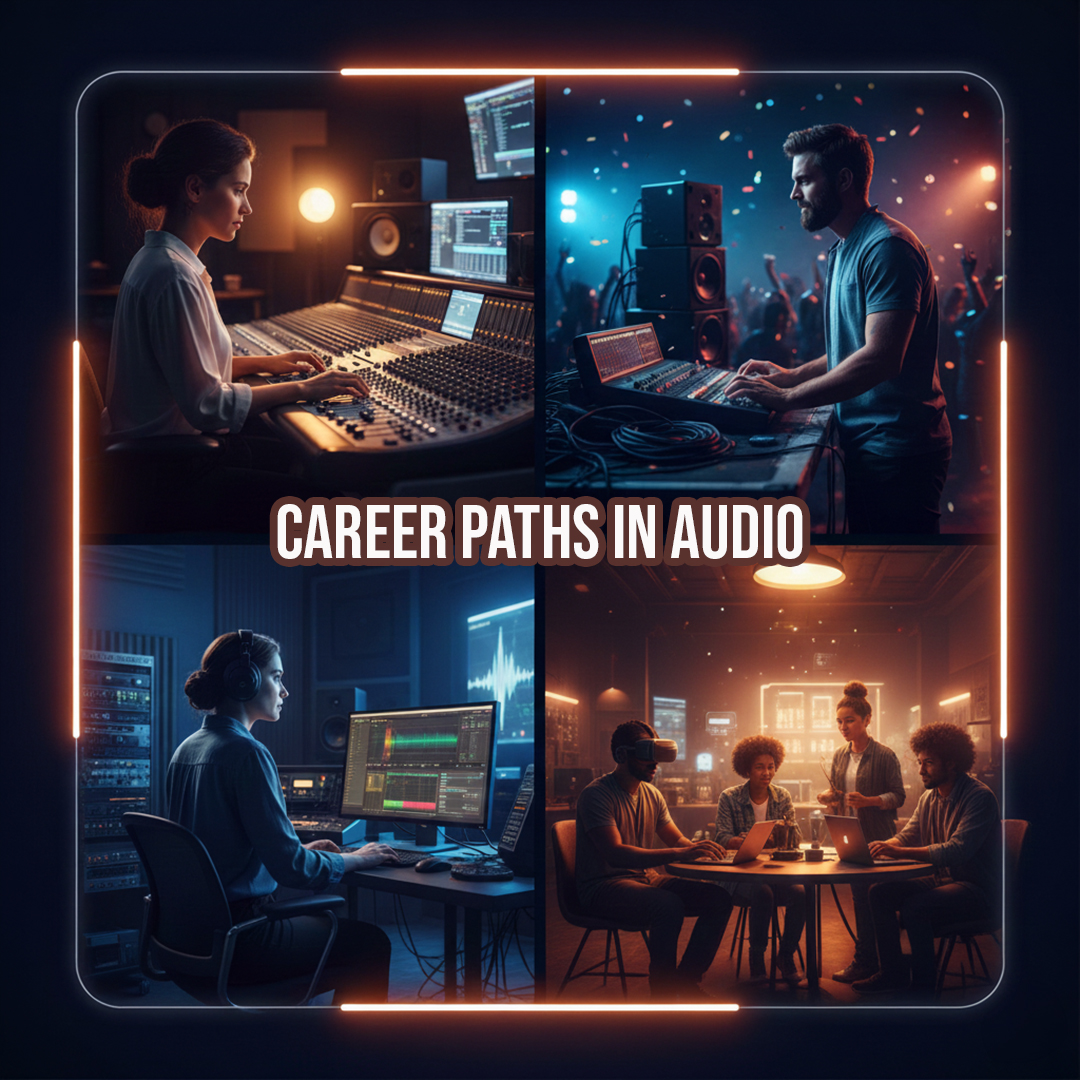
For a long time, “working in audio” was framed as a single destination:
Get into a studio. Become an engineer. Hope it works out.
But the reality of today’s audio industry is far more expansive (and far more flexible) than that outdated narrative suggests.
Audio is no longer one lane. It’s an ecosystem.
Whether you’re drawn to the precision of mastering, the adrenaline of live sound, the intimacy of studio sessions, or emerging fields that didn’t exist a decade ago, there are more ways than ever to build a sustainable, fulfilling career in sound… if you understand the landscape.
This is a breakdown of the real paths audio professionals are taking today, and how people are carving out careers on their own terms.
🎙️ The Studio Path: Recording, Mixing, and Creative Engineering
This is the most visible and romanticized path… and for good reason. Studio engineers are deeply embedded in the creative process, helping artists translate emotion into sound.
What studio engineers actually do:
-
Record vocals and instruments
-
Shape tone, balance, and dynamics
-
Collaborate creatively with artists and producers
-
Manage sessions, files, and deliverables
-
Often act as part-therapist, part-problem solver
The reality:
Studio work is rarely linear. Many engineers start as assistants, interns, or freelancers, gradually building trust and credits. Success here is built on skill, consistency, relationships, and reputation: not just gear.
Today, studio engineers often work hybrid setups:
-
Recording locally or at home
-
Mixing remotely for artists worldwide
-
Collaborating digitally instead of being tied to one physical studio
This flexibility has opened doors for engineers who might never have had access to major studios in traditional industry hubs.
🎚️ Live Sound: Where Technical Precision Meets Chaos
Live sound is a completely different mindset.
There’s no “undo.” No revisions. No recalls.
Common roles in live sound:
-
Front of House (FOH) engineer
-
Monitor engineer
-
Systems engineer
-
Tour audio tech
-
Venue sound engineer
Why people choose live sound:
-
Fast-paced environments
-
Immediate feedback
-
Strong team culture
-
Opportunities to travel
-
Clear career ladders through touring and venues
Live sound engineers need deep technical knowledge, calm under pressure, and strong communication skills. One mistake can affect thousands of listeners, but when it goes right, the reward is unmatched.
Many engineers move between studio and live sound, using each discipline to strengthen the other.
🎧 Mastering: The Art of Restraint
Mastering engineers are often misunderstood and quietly essential.
Their job isn’t to reinvent the music, but to translate it.
What mastering engineers focus on:
-
Final tonal balance
-
Loudness consistency
-
Playback translation across systems
-
Technical compliance for streaming, vinyl, broadcast, and Dolby formats
-
Quality control and delivery specs
Mastering requires:
-
Exceptionally trained ears
-
Deep technical knowledge
-
Incredible attention to detail
-
Emotional neutrality
This path often appeals to engineers who enjoy precision, consistency, and problem-solving more than hands-on production. Many mastering engineers work independently, serving clients globally.
🎛️ Dolby Atmos & Immersive Audio: A Growing Frontier
Immersive audio has opened an entirely new lane.
Engineers specializing in Dolby Atmos and spatial audio are now working across:
-
Music
-
Film and TV
-
Gaming
-
Live immersive installations
-
Virtual and augmented reality
This path blends creativity with advanced technical workflows and is becoming increasingly valuable as platforms adopt immersive standards.
Engineers with Atmos skills often command higher rates and work across multiple industries, making this one of the fastest-growing specializations in audio today.
🔊 Post-Production, Broadcast, and Media Audio
Not all audio careers live in music.
Many professionals work in:
-
Film and television post-production
-
Podcast editing and sound design
-
Advertising and brand audio
-
Broadcast and live-streaming
-
Sports and esports audio
These roles prioritize storytelling, clarity, and consistency, often within structured production environments. They offer more predictable schedules and long-term stability compared to music-only careers.
🧠 The “Beyond”: Education, Tech, and Entrepreneurship
Some of the most sustainable audio careers exist outside traditional engineering roles.
Engineers today are also:
-
Building audio software and plugins
-
Teaching and mentoring
-
Creating educational content
-
Consulting for studios and brands
-
Running their own studios or platforms
-
Working in music tech startups
Audio knowledge is increasingly valuable in adjacent industries, especially as technology, content creation, and media continue to merge.
🌍 The Modern Audio Career Is Rarely One Thing
Here’s the most important truth:
Very few successful audio professionals do only one thing.
Most combine multiple paths:
-
Studio + live sound
-
Mixing + mastering
-
Engineering + education
-
Audio + tech
-
Creative work + business ownership
This diversification isn’t a failure… it’s a strategy.
The audio industry rewards adaptability, curiosity, and people who build careers instead of chasing titles.
🚀 Building Your Own Path
There is no single “correct” route in audio anymore.
What matters is:
-
Developing real skills
-
Building trust and reputation
-
Understanding your strengths
-
Staying open to evolution
-
Choosing sustainability over ego
Platforms like EngineEars exist because the industry has changed. Engineers no longer need to rely solely on proximity, gatekeepers, or traditional studios to build careers. Today, talent can be discovered, booked, paid, and scaled globally.
The tools are there. The paths are open.
🎶 Final Thoughts
Audio is not a narrow profession, it’s a vast, evolving landscape.
Whether you find your home in studios, on stages, inside Atmos rooms, or beyond traditional roles entirely, there’s space for you if you’re willing to explore it.
Your career doesn’t have to look like anyone else’s.
It just has to work for you.
And in today’s audio industry, that freedom might be the most powerful opportunity of all.
